Friday, December 1, 2017

Confirmed Kill: Castlevania: Symphony of the Night


Title: Castlevania: Symphony of the Night
Original Release: March 20, 1997 (PS1)
Finished Release: North American PS1 Release (1997)

*General spoiler warning for the Castlevania series*

I've always been what you might call a "distant fan" of the Castlevania series.  That is to say, I've always really liked the series, its characters, its setting, ongoing storyline, etc., but I never got hugely into it, at least not directly.  I had played a majority of the games here and there, I had a working knowledge of the series' timeline, and I cried foul when Castlevania: Lords of Shadow came out and rebooted the whole thing.  But, for the most part, the series has always been on my periphery, and I had only ever finished two games in the series: Lament of Innocence on PS2 and Portrait of Ruin on DS.

Flash forward to earlier this year, when I was going through my at-least-twice-a-year tradition of getting really really into Gothic horror.  This time around it manifested itself as a sudden-but-extreme interest in the fantastic Ravenloft setting for Dungeons & Dragons.  Seriously, I don't know if I'll ever run a roleplaying campaign, but Ravenloft is one of the two campaigns styles I would most love to play.  The other, for those interested, is a BPRD campaign.

Anywho, I was reading anything Ravenloft-related that I could get my hands on.  But sometimes one medium just isn't enough, y'know?  So I began casting about for video games I could play that would give me that Ravenloft feel.  I would find out later that there is an actual Ravenloft PC game that I was completely unaware of.  Not knowing that, I went to the next best thing: Castlevania.  It helped that this was right around the time the Castlevania Netflix series came out (which maybe I'll review one day), but before long I was knee-deep in the series.

I dabbled here and there in various side games (including loading up my original save in Portrait of Ruin), played a fair bit of Circle of the Moon and Aria of Sorrow.  My wife was right along for the ride, playing Lament of Innocence, at my suggestion, for the first time.  She would finish it before too long, but one game kept calling out to me: the shining jewel in the series' crown.  A game that served as a sea change in the direction the series would take from then on.  The official first "Metroidvania" in the series: Symphony of the Night.

Now, first of all, let me just say that I don't think I've ever heard anyone say anything bad about this game.  Which is interesting, because there tends to be a pretty big camp divide between people who prefer the classic games that came before SotN and those who prefer the games that came after it, emulating its style.  But both camps can agree on one thing: what Symphony does, it does very, very well.

We'll start, as we usually do, with the story.  We begin with the ending of the previous game in the series, Rondo of Blood (well, kind of).  We momentarily play Richter Belmont (my personal favorite Belmont, thank you very much) as he makes the final approach to Dracula's chamber, eventually coming face to face with the Dark Lord himself.  The two exchange some wooden dialogue before engaging in some epic whipicuffs.

Richter ultimately comes out on top in the confrontation, because he's Richter Belmont and that's just how he do.  Ironically it's the last fight he'll win in this game, but I'm getting ahead of myself.  Dracula explodes in glorious flames 'n' stuff, and the game is over.  Well, that game is, anyway, we still have a long way to go.

A few years later, Richter disappears because no Belmont can have a happy life.  In this case, he reappears a further year later, summoning Dracula's castle and attempting to resurrect Dracula himself.  Why Richter, why?!

The why will have to wait, however, as the reappearance of the evil castle has awoken Dracula's half-blood son Alucard, who's been asleep for a few hundred years by this point (since the end of Castlevania III, roughly).  Alucard is not his dad's biggest fan, and he has no patience for all these goings-on.  So, since he's (apparently) the only one capable of doing so, Alucard takes up his sword for a one-dhampir assault on Castlevania, to bring this renegade Belmont to heel and put a halt to his father's resurrection.

So that's the setup, and, no, it's not overly complicated.  But it doesn't need to be.  There are twists and turns along the way, but for the most part things go the way you'd expect them to.  Again, this isn't a bad time, since the story is told well (aside from the questionable voice acting), and it's really not any more complicated than it needs to be.

Alucard is a pretty cool character, although a lot of that comes from the fact that he's specifically designed to be cool, which can actually take away from it a bit.  Maybe that sounds silly, of course you want your characters to be cool, but Alucard is one of those characters where it feels like the creators went down a checklist of "cool things" and just checked them all off.  Again, this isn't a bad thing, he's just not the most interesting character in the world as far as I'm concerned.

One thing I will outright complain about regarding Alucard isn't really his fault.  See, I like the so-called Metroidvania-style games.  It's actually just a style I'm a big fan of in general.  Hell, I'm playing two games in this style (Hollow Knight and Axiom Verge).  So I don't really have a problem with the fact that later games usually followed in Symphony's footsteps in that regard.  What I do have a problem with is how every main character after this was basically just Alucard again.

We skipped it with Nathan in Circle of the Moon (which isn't even canon, apparently), but we then had Juste Belmont in Harmony of Dissonance, and Soma Cruz in Aria/Dawn of Sorrow.  Seriously, just take a look.

Alucard (Symphony)               Juste (Harmony)
Soma (Aria)
             
Please, forgive me when I say that this is absolutely ridiculous.  Soma's not so bad, I guess, since it kinda-sorta makes sense with his storyline, but Juste is just(heh) a bridge too far.  He's a Belmont; they're just normal humans who are good with whips.  It also doesn't help that the other major Gothic(ish)-styled action game from around this time also featured a white-haired half-human pretty boy, but Castlevania can't really be blamed for that.  Ironically Alucard wouldn't even have white hair the next time we'd see him.

Anyway, enough of that tangent.  I don't mean to rag on things too much, since I genuinely love this series.  This is just something that's bothered be for a while.

Symphony of the Night made the intelligent choice of abstaining on a switch to 3D, unlike its N64 brethren.  Instead, the focus seems to have been on taking the (then)massive power of the PS1 and using it to make the most visually-impressive 2D action game they possibly could.  I'm more than happy to say that they achieved this goal phenomenally.  The fact that this game has never gotten a legitimate HD re-release is a crime.

The game is no slouch in the audio department, either.  In a series famous for kickass music, SotN carries within it some of the absolute best.  Sound effects are, on the whole, awesome and satisfying, especially the spiffy little sound that plays whenever Alucard levels up.

And then we come to the gameplay itself, which more than lives up to its reputation.  Symphony of the Night still probably isn't my favorite Castlevania game (that's probably Portrait of Ruin, if only for nostalgia), but actually playing through it has given me a whole new appreciation for it.  I know a lot of people decry its lack of challenge (especially compared to previous games), and I can understand that, but at least it's a good game to kick back and play for fun.

That's not to say that the game is always easy, and it's also not perfect.  Some portions of the castle are a nightmare to get through, mainly due to throwing tons of enemies at you, completely at random.  Now, flooding the screen with enemies and obstacles is nothing new to the Castlevania series, but in previous games they would typically follow a pattern.  Things here don't really do that, making certain sections overly frustrating.  It wouldn't be quite so bad if you didn't have to go through them multiple multiple multiple times as you're trying to find the next place to go to progress.  And speaking of progression...

So, Symphony of the Night has one of the weirdest cases I've ever seen of multiple endings.  Basically, the "final boss" of the bad ending is actually (roughly) the mid-game boss.  If you haven't done certain things or acquired certain key items, you fight this boss, and the game ends.  You get an unsatisfying ending and go on about your life.

However, if you've been thorough in your exploration and do things the right way (I'm being intentionally vague), you beat that boss, then open up the second half of the game, which is another whole castle!

Now, I'm really not sure how I feel about this.  On the one hand, it's a nice feeling to know that you've done things right, and it's satisfying to be rewarded for exploring every nook and cranny.  At the same time, it's really weird to keep what is essentially half the game locked away from people that focus less on exploration and more on getting through it.

There's also the fact that the "reward" of the second castle isn't overly satisfying.  It sounds like it would be a great time, a whole new castle and all that, but it's not that at all.  It's actually just the first castle, but turned upside-down.  It is, admittedly, pretty cool to see how the progression through certain rooms changes due to everything being flipped, but most of the time it just feels uninspired.  It's really only a few steps above Ghosts 'n' Goblins' infamous "beat the game again" demand.

Still, exploring the castle is enjoyable the first time around, and only mildly less so the second time, and it's all wrapped up in a package that's great to look at and listen to.  It's easy to see why Symphony of the Night is so fondly remembered, and I'm proud to say I finally put in the time to experience it.

Until next time!

Current interests:
Listening - Various
Playing - Hollow Knight (2017)
Reading - Dune (Frank Herbert, 1965)
Watching - NXT TakeOver: WarGames (2017)

Monday, November 27, 2017

Confirmed Kill: Shovel Knight: Plague of Shadows

Hey guys, sorry for the delay on this post.  American Thanksgiving was last week and it wound up taking up a lot of my time.  Still, I had a great time, and I hope you all did too.  So, with that out of the way, let's move on!

Title: Shovel Knight: Plague of Shadows
Original Release: September 17, 2015 (Multiple)
Finished Release: Shovel Knight: Treasure Trove (Switch, 2017)

*Potential spoilers for Shovel Knight: Shovel of Hope*

So let's just get this out of the way.  Yes, I'm reviewing the base Shovel Knight game and Plague of Shadows (and Specter of Torment) separately, and counting them as two separate finished games.  The reason for this is manifold, but I'll stick to two good reasons.

One, they came out more than a year apart, and each had pretty much their own separate development cycle.  And two, they're both full-length games in their own right.  In fact, I actually have a slightly longer playtime recorded in Plague of Shadows than Shovel of Hope.

And yes, it lets me inflate my "finished games" number for the year.

So anyway, let's talk about Plague of Shadows.  See, back during the development of the original Shovel Knight game, Yacht Club held a poll.  Fans could vote on the top three members of the Order of No Quarter they would like to see become playable characters.  The three winners would receive their own add-on story content, with full storylines and gameplay campaigns as DLC.

The winners, and subsequent DLC campaigns were:
#1 Specter Knight in Specter of Torment (which actually got released second)
#2 Plague Knight in Plague of Shadows (released first)
#3 King Knight in King of Cards (not yet released at the time of this writing)

Note: these are not the three I would have chosen.  I like all the characters in Shovel Knight, but it's kind of funny that none of these three choices are ones I would pick, even though I like all of them.  For those curious, the three I would pick would be Polar Knight, Treasure Knight, and Propeller Knight, not necessarily in that order.

Still, the three we got are still great characters in their own right, and who knows?  Maybe someday we'll get all of the Order as paid DLC.  But destiny dictates that we are here to discuss Plague of Shadows, so let's do just that.

As mentioned before, in Plague of Shadows you play as Plague Knight, one of the stage bosses that Shovel Knight goes up against in Shovel of Hope.  Plague Knight's story takes place alongside Shovel Knight's, but it's told from Plague's point of view.  The interesting thing about that is that Plague is A. crazy and B. not a little bit self-aggrandizing.  So it goes without saying that the events herein are embellished slightly, which basically serves as a way of explaining how, in this game, Plague Knight actually won his fight with Shovel Knight.

Anyway, Plague Knight is attempting to create a potion that will make him the most powerful person in the land.  Unfortunately (or possibly fortunately), the ingredients he needs for the potion are guarded by the other members of the Order of No Quarter, unbeknownst to the knights themselves.  And so Plague Knight, having little sense of loyalty or camaraderie, sets out to take down his compatriots and concoct his potion.  Things are, of course, more complicated, and we learn a bit more about how Plague Knight really feels along the way.

So the story here is just as quirky-yet-heartfelt as the original, if not moreso.  Shovel Knight is a great mostly-silent protagonist, but Plague has the advantage of getting to cut loose.  He's mildly psychotic and loves explosions (we'll come back to that), but this game adds a surprising amount of depth to him.  I won't say too much, but suffice it to say that, while he may be a psychopath, we learn here that he is not a sociopath.  Well, not completely, anyway.

Along with this new story comes a whole new supporting cast.  Some are new characters, some are returning, but nearly all of them are lovable.  In particular, one of my favorite minor characters from the original has a greatly expanded role in Plague Knight's story, and everything is the better for it.  We also get a bit of insight into the history and motivations of other lesser-used side characters.

So the story and characters are fun and great.  The graphics and audio, as well, are just as great as they were before.  There's a fair amount of reused assets as far as visuals go, but not to the point of it feeling boring.  The soundtrack is, as far as I could tell, more or less completely new.  I didn't enjoy it quite as much as the original, but it's still got more than a few good tunes.

Now let's talk about something serious.  Yacht Club could have played it safe.  They could have taken the easy way out.  Plague Knight could have just been "Shovel Knight with bombs."  I am happy to report that that is not the case.  Not at all.

Plague Knight feels and plays completely different from Shovel Knight.  And his bombs aren't just a fun little thing he has, they're intrinsic to him, as they honestly should be.  The bombs not only do damage, they're a major part of his movement controls, allowing you to use them in mid-air to slow your descent.  He also has a separate double jump, which Shovel Knight didn't have.

And the bombs themselves aren't just fun and practical, they're also customizable!  See, your basic bomb is made up of three parts: powder, casing, and fuse.  There are several kinds of each part, and they can be mixed and matched without limitation.  This leads to a certain amount of strategic assessment, wherein you'll get used to looking at a situation and quickly adjusting your bombs to overcome it.  I found it quite an enjoyable little system, and would sometimes change things up just for fun.

Now, it must be taken into consideration that the altered mechanics are a bit of a double-edged sword.  Plague Knight's controls, especially his jumping, are more complex and, compared to Shovel Knight's relatively simple controls, could lead to a more challenging experience for certain players.  

Movement here is quick and versatile, and opens up a bit more options for many given situations.  Unfortunately, they also feature a much steeper learning curve.  Add to this the fact that Plague Knight feels just that extra bit more fragile, and it ultimately leads to a more challenging experience overall.

For me this level of challenge wasn't insurmountable, and I enjoyed myself all along the way.  Some people, however, may not have a good time, especially if they prefer the relative simplicity of Shovel Knight.  It's a personal preference thing, and there's nothing wrong with not enjoying a more difficult game.

Either way, though, if you loved the original, Plague of Shadows is definitely a high-quality follow-up.  If Shovel of Hope didn't quite convince you that this is a world worth expanding, then this one definitely will.

Until next time!

Current interests:
Listening - Permanent Waves (Rush, 1980)
Playing - Hollow Knight (2017)
Reading - Kamen Rider Spirits (2001)
Watching - Kamen Rider Drive (2014)

Wednesday, November 22, 2017

Confirmed Kill: Shovel Knight: Shovel of Hope

Title: Shovel Knight: Shovel of Hope
Original Release: June 26, 2014 (Multiple)
Finished Release: Shovel Knight: Treasure Trove (Switch, 2017)

Earlier this year, I was one of the lucky few to acquire a Nintendo Switch on launch day.  Hell, going by the press zeitgeist at the time, I was one of the lucky fewer to have absolutely no problems with either my switch or the controllers.

So, it's a brand new game system, and what's the most important decision you have to make?  Well, that would be the first game to buy for it, of course.  For me, like most people (I would assume), that first game was a no-brainer: The Legend of Zelda: Breath of the Wild, of which I bought the collector's edition.  It was a really good day.

But I wasn't quite satisfied.  I wanted to play the Switch, but not always something as big as Zelda.  Sometimes you want a snack.  So when it came time to buy a second game (and because Pocket Rumble still hasn't actually come out), I snatched up Shovel Knight: Treasure Trove.

I had been interested in Shovel Knight since I discovered the Kickstarter campaign for it... about six months after it ended.  What I saw honestly kind of blew me away.  I know it's old news by this point, but indie game development has really become something worth keeping your eye on.  And yes, I know indie studios had already been churning out great games for years by this point.  But Shovel Knight was different.

Shovel Knight was one of the first (if not the first) indie games that caught my eye as being more than just a collection of great game mechanics.  The team at Yacht Club Games were building a world.  They were crafting a great game with a fun throwback art style and a unique story, but the greatest hook of all was the character of Shovel Knight himself.

Creating an iconic character is an extremely difficult proposition.  Trust me, I've been trying for more than ten years to come up with one great character that I can truly count on.  But, whether by accident or design, Yacht Club had created one.  Shovel Knight is, in my mind, what Mario was in the '80s and '90s: a simple yet elegant character that could not only show what his game's genre could do, but could also rise beyond the game he's in and enter the mainstream, at least for gamers.  And no, he wasn't the first indie game character to do this, but to me he was the first to really blow the door open.

And now indie devs are taking the characters (and stories) in their games just as seriously as the mechanics of the games themselves.  And now we have great, dare I say iconic, characters all over the place: Owlboy, Hollow Knight, Slugcat, Flinthook, Cuphead, and wow they're all just two words shoved together.  But y'know what?  It's fine because I love them.  Again, I'm not saying Shovel Knight caused all this, but it was the first game that showed me that it could be done.

Anyway, enough of that.  So yeah, I had had my eye on Shovel Knight since its release, but had never managed to convince myself to go for it.  But then I discovered the Treasure Trove collection on Switch.  For those not in the know, Treasure Trove is as complete a Shovel Knight experience as you can get, with the base game and all current and future expansion content included.  Today I'll be focusing on the base campaign, recently renamed Shovel of Hope, with the other games getting reviews of their own because, quite frankly, they deserve it.  So how is it?

Well, let me get this out of the way immediately: if you have any interest in Shovel Knight and, preferably, access to a Nintendo Switch, go buy it right now.  I mean it, you've read enough of my rambling.  Seriously.  But hey, if you want to read more, far be it from me to deny you.

So what exactly is Shovel Knight?  Well, it's an 8-bit action platformer with light RPG mechanics and loads of secrets.  Basically, imagine you fused Mega Man with the Ducktales NES game.  And yes, I know that would give you the Darkwing Duck game for the same system, but imagine you used the Potara earrings instead of the fusion dance.  You'd get Shovel Knight.

We'll start with the story.  It's simple, maybe even basic... at first.  There's a bit more depth than you might expect, though a lot of it admittedly only shows itself in the expansion content.  Still, what's here is fun to see.

Shovel Knight and his (or her) partner (in more ways than one?) Shield Knight are treasure hunters, living exciting lives of high adventure.  All this changes, however, when exploring the mysterious Tower of Fate goes awry.  Shovel Knight barely escapes with his (or her) life, but Shield Knight isn't so lucky.  The Tower is sealed, and Shovel Knight, wrought with grief, gives up his heroic lifestyle.

Time passes, and in due time, the land is overrun by the foul monsters serving the Enchantress (or Enchanter) and a group of knights (all with a particular theme) called The Order of No Quarter.  With the land in jeopardy, and the Tower of Fate somehow involved, Shovel Knight has no choice but to once again take up his eponymous digging implement in the name of good.

Oh, and if you're wondering why my gender pronouns seem optional, it's because Yacht Club recently added a feature wherein you can choose the sex and gender of each and every principal character.  That means Shovel Knight, Shield Knight, the Enchantress, and all of the Order of No Quarter.  New opposite-sex designs were made for all of them, and the sex and gender options aren't even tied together.  Outside of being a big step forward for inclusion in video games (which it is), it's also just a really cool bit of customization.  I didn't actually use it in my game, since I wanted the experience as originally planned, but I'll never complain about options.

The presentation, both visually and aurally, are top-notch examples of what the game is trying to bring across.  I know that pixel graphics are a big point of contention these days, with a lot of people thinking it's been done to death.  I agree to a certain extent that the aesthetic might have become a bit too common, but Shovel Knight is an entirely different beast.  Yacht Club didn't decide to use 8-bit graphics because it's popular.  Instead, they set out to make an NES game, and that's exactly what they did.  Pretty much the entirety of the presentation seems to have been approached with an eye for accuracy to what the NES would have been capable of.

Okay, so it's meticulously thought-out throwback, sure, but is it actually appealing?  Well, I guess in the end it's going to come down to personal preference.  For me personally, it's amazing.  The color palette is bright and vibrant.  There's tons of little attention to detail, and the characters are all extremely charming.  There's not a single dud among the principal cast, and a lot of that is owed to the character sprites themselves.  They're all so quirky and unique and memorable.  And even a lot of the side characters stand out as being memorable in their own right.

Beyond that, the music and sound effects are spot-on.  Nearly all the tunes are catchy, and I found myself humming along quite a bit.  The sound effects are satisfying, sometimes silly, but just a real treat to listen to.

And after all that, we come to the gameplay.  And let me tell you, I was not disappointed in the slightest.  The controls are tight and responsive. Shovel Knight himself does what you tell him to do when you tell him to do it.  It's amazing, too, since it's a relatively simple control scheme: run, jump, shovel, subweapon.  It's pretty basic, and yet within that framework there's a surprising amount of complexity, especially when you add in all the different subweapons, which can sometimes dramatically change the way the game is played.  I don't know how else to say it, it all just feels right.

So yes, the basic campaign for Shovel Knight, retroactively named Shovel of Hope, is a massive success.  It hits every target it intends to and then some.  It is a perfect example of what a throwback game should be.  It pays homage to the games that came before it while simultaneously doing its own thing.  And it does all of it extremely well, and, more often than not, even manages to surpass the classics it seeks to emulate.

Until next time!

Current interests:
Listening - Various
Playing - Hollow Knight (2017)
Reading - Kamen Rider Spirits (2001)
Watching - Kamen Rider Drive (2014)

Friday, November 17, 2017

Confirmed Kill: Game of Thrones: A Telltale Game Series

Title: Game of Thrones: A Telltale Games Series
Original Release: December 2, 2014 (Episode 1, Multiple)
Finished Release: Complete Series (PS3, 2015)

Note: I will do everything I can to keep from spoiling the first few seasons of Game of Thrones, but I'm putting a warning here just in case.  So yeah.  Warning.

Note 2: I know the TV series is based on a book series, but the game is based on the TV series.

Full disclosure: I am not the biggest fan of Game of Thrones.  That's not to say it's no good, it's actually (usually) quite good at what it is and what it does.  It's just not my cup of tea.  In point of fact, watching it actually stresses me out.  That said, I do occasionally watch huge swathes of the series all in one go, so that I can always be caught up to what happened... two seasons ago.

One thing I am a fan of, however, is Telltale Games.  I have been ever since the release of their first Sam & Max game.  Their first huge success was probably The Walking Dead game they made, and we basically have that to thank for the current trend of episodic storytelling in video games.  Whether that's a good thing or a bad thing is up to you, but in my experience it can be, at least, a very engaging thing, if used correctly.

So yes, the fact that Telltale made a Game of Thrones series was an exciting prospect for me.  And it has one of my favorite things: new original characters you've never heard of in the main series, but are suddenly very important in the spin-off.  I'm not being facetious there, that really is one of my favorite things.  Maybe I'll talk about it someday.

In fact, it was my desire to play this game that eventually forced me to catch up to the show, at least to the point where the game takes place.  How does it hold up?  Let's find out.

The new characters in this case are the members of House Forrester, bannermen of House Stark from the TV series.  The Forresters have an important job: cultivating and harvesting ironwood trees.  Ironwood is really awesome wood, better than all other woods, and this job of theirs has to be where their name comes from.

Anyway, the Forresters aren't the only House around with ironwood trees.  Their biggest (and apparently only) competition in this regard are the Whitehills, another banner House to the Starks.  The Whitehills are also, also exclusively, awful people.  So yeah, Forresters good, Whitehills bad.  GoT it?

So the Forresters themselves are pretty cool, and not at all stand-ins for the Starks. /sarcasm

Okay, all kidding aside, they are generally a good bunch of characters.  But let's be honest with ourselves here: Gregor is Ned; Elissa is Catelyn; Rodrik is Robb (their names even start the same); Mira is Sansa; Ethan is Bran; Talia is Arya; and Ryon is Rickon (similar names again!).  No, they're not all exactly the same characters, and their fates are often quite different.  But they have the exact same number of kids, in exactly the same gender order.  To be fair, though, I actually can't quite remember who's older between Bran and Arya.  Apparently neither could the Telltale guys, since Ethan and Talia are twins.

Also, Jon Snow is missing from that list because the situation is a bit more complicated.  Asher is the second son of the Forrester family, and he's not a bastard.  He is in exile, making him kind of like the opposite of Jon in some ways.  He's also a lot less moody.  On the other hand, we have Gared Tuttle, who isn't a member of the family at all but rather the nephew of Duncan, castellan of House Forrester.  Gared also happens to be squire to Lord Gregor himself, and he's considered to be a member of House Forrester, for reasons I'm a little unclear about.  I don't want to spoil anything, but it's his story that ultimately winds up being a bit more like Jon's.  Hell, he even meets him!

And let's just get this out of the way right now: Gared Tuttle is, far and away, my favorite character in the series.  And I mean the entire series, TV show included.  Part of the reason for this is just his personality; he's just a down-to-earth dude always keeps moving forward no matter what life throws at him, because that's his duty.  The other reason for this is that he's a stone cold, capital "b" Badass.

See, throughout the game, every now and then, there are sections of gameplay that essentially play out as just a long series of action commands.  You know the ones: a circle (or B, whatever) shows up on the screen, you press it real quick, and you don't die.  Well, if you're consistently successful with the action commands, Gared's competence rises to Batman levels.  I'm dead serious here.   At one point in my game he single-handedly took on five or six dudes at once.  This is Game of Thrones, no one does that!  Hell, there's one section where he's fighting a dude, and doing everything he can to not kill the dude, dude dies anyway.

Gared Tuttle breathes death upon his enemies.

Anyway, I could go on about Gared all day.  What about the story?  Well, it's hard to talk about without giving things away.  Suffice it to say that it's definitely Game of Thrones.  Everything starts out more or less okay before completely falling apart. And then, every time it looks like the good guys are getting ahead, the omnipresent whim of the writers shows up to slap them back down like some sort of mean-spirited Master Hand (Crazy Hand?).

I'm kidding, mostly, but there is a definite sense of futility about the game.  And yes, that's true to the source, but the problem here is that you're not just watching it, you're living it.  After a while every single choice or branching dialog option became a source of stress, as I rendered the in-game timer obsolete by just pausing.  I would spend minutes at a time ruminating on what to say to any given character.  So, at the very least, it felt like I was in Game of Thrones.

The problem is that most of it was ultimately pointless.  Like Final Fantasy VI, this was a game that Rachel watched me play, and after sitting through however many hours of me mathing out every line of dialog, she finally just gave up and said "Remember, it's the illusion of choice."  And that's probably my biggest complaint.

Now don't get me wrong, there are definitely very big things that can be different from one play-through to the next.  Some characters live while others die, some become enemies instead of allies, and so on and so forth.  I imagine, if Telltale ever actually makes a second season, these big differences will have resounding effects therein.  And really this is more of a problem with me than with the game; I shouldn't have gotten so stressed over every single decision.  But hey, you can't help how you feel, right?

Oh, another, more objective issue, was the game's performance.  I played it on PS3 because that just happened to be what was at hand, and maybe that's why.  Either way, load times took forever; slowdown was not infrequent, nor was outright freezing; in one climactic cutscene the game's audio just completely gave up and went home early for the day.  Again, if I had played on a current-gen system, maybe these issues would have been mitigated, but that's not the case.

Still, Telltale's Game of Thrones is about as close as a video game can come to a perfect representation of the TV show.  If you like the series, if you like story-driven games, and if you can overlook hours of stress leading up to an ultimately unsatisfying cliffhanger for a second season that may never come, well, you'll probably love it.

And best of all: Gared Tuttle.

Until next time!

Current interests:
Listening - Graceland (Paul Simon, 1986)
Playing - Yakuza 0 (2015)
Reading - Kamen Rider Spirits (2001)
Watching - Mystery Science Theater 3000: The Return (2017)

Wednesday, November 15, 2017

Confirmed Kill: Final Fantasy VI

Title: Final Fantasy VI
Original Release: April 2, 1994 (Super Famicom)
Finished Release: Final Fantasy III (SNES, 1994)

Here we are again, today with yet another piece of gaming history.  We've got a lot to get through today, so let's hop to it.

I love Final Fantasy, and have for a good twenty years now.  Final Fantasy VII on PC(!) was the first RPG I ever played.  It's pretty accurate to say that that game changed the world.  But we're not here to talk about that (maybe next year).  See, oddly enough, I had played every numbered Final Fantasy game, but only ever finished one (Final Fantasy IV on DS, for anyone curious).  All that changed last year.

In mid-2016, my wife and I moved out of her parents' house, into our own apartment.  Our roommate is a very old friend of my wife and her family.  Her name is Rachel, and she loves Final Fantasy, especially the games she played when she was a kid.  And she loves watching other people play the games she loves, and promising her that I'll play is enough pressure to actually make me do it.  All of this is to say that, since moving in here, the number of Final Fantasy games I've finished has increased from 1 to 5, and I might squeeze in one more before the year's out (no promises).

Two of the FF games I've finished recently, X and X-2, won't be discussed this year, since I finished them late last year.  I'm sure I'll talk about them at some point, though, since X is actually my favorite in the series.  No, instead, we're gonna be focusing today on Final Fantasy VI.  Or, as my SNES cartridge says, Final Fantasy III.

Okay, so you probably know the story, but just in case I'll tell it anyway.  To make a long and complicated story as short as possible, it goes thusly:  the first Final Fantasy came to North America relatively late in the life cycle of the NES, and the SNES was on its way.  Square made the decision to skip Final Fantasy II and III, both of which were on the Famicom (NES), and jump straight to the first game to be released on the Super Famicom (SNES), that being Final Fantasy IV.

However, to keep the numbering would cause a little confusion, so they changed the title of Final Fantasy IV to Final Fantasy II, thereby causing generations of confusion.  Then they also skipped the next game, Final Fantasy V, and jumped straight to VI.  And they changed its name to Final Fantasy III, and that's the version I played.

Holy frijoles.  Y'know, it's funny, I've known that story for years, yet trying to actually type it out gives me a headache.

ANYWAY, that's the game we're talking about.  Final Fantasy VI/III, for the Super Nintendo.  Let's get to it already.

I don't want to give too much of the story away for those who haven't experienced it before.  The basic gist is that you begin the game as Terra, a powerful mage who has been brainwashed into serving the tyrannical Gestahlian Empire.  In short order, however, she's freed from their clutches by a thief (treasure hunter!) by the name of Locke.  She joins a band of rebels, they fight against the Empire (yes, I know, just get past it), and there's tons of twists and turns along the way.

The story is actually pretty epic for its time, and it's a pretty engaging one to boot.  I knew some of the most major twists (but not all of them) going in, but a lot of the more minor turns in the story genuinely took me by surprise.  It's also fairly dark, and deals with some very mature themes such as genocide, suicide, and several different forms of love.  It plays out like a tragedy, although an ultimately hopeful one.

The ambition present in the game's storyline manages to bleed into other aspects of the game as well.  The character roster contains a whopping 14 possible permanent party members (still the largest in the series), with a couple short-term guest characters along the way.  The crazy thing is that pretty much all of them are likable, at least the ones that speak. The number of named villain characters is relatively small, but the world is packed with tons of tertiary and minor characters.

The world is large and filled with secrets, and (spoilers) about halfway through the game the map changes completely, and the story becomes totally nonlinear.  Unfortunately I actually found the second half of the game to be a bit of a disappointment compared to the first half.  This is actually indicative of my one and only real problem with the game, but I'll come back to that in a bit.

First, more praise.  The game is drop dead gorgeous.  I mean it.  This was near the end of the life of the SNES, and Square managed to squeeze every drop of power the tiny system could muster.  The character sprites are unique, vibrant, and expressive.  It may be kind of dumb to say "every character has a distinct look," but I'm not really sure how else to say it.  The sprites capture the characters perfectly.

The backgrounds are no slouch either.  Things are bright and vibrant when they need to be, dark and moody elsewise.  I mean, honestly, the game tends towards the dark. It's a mood thing, but there's still room for light, and I often found the lighting in the game to be very appealing to me.  There's also incidental art here and there, a castle or a mountain or what have you, and it feels like you're looking at a painting.  It's all just really nice to look at.

And then we have the music.  Holy mother, the music.  Bear with me as I digress.

I would never say that older automatically equals better.  I feel this way about pretty much everything, but video game music is a sticking point for me.  Have you noticed how much music in video games has changed?  It's all moody and atmospheric and "sweeping," whatever that means.  And it's generally fine and enjoyable, but it just isn't the same.

Seriously, I hate to be the guy saying "back then we had," but back then we had soundtracks full of tunes, songs for every character, themes for every level or dungeon or whatever.  I'm not saying it was better, necessarily, but it was definitely more memorable.  And FF6 is a perfect point for me to use to prove that it isn't just nostalgia talking.  See, I was unfamiliar with most of FF6's soundtrack.  I knew Terra's theme and Dancing Mad, and that was it.  It's now one of my favorite video game soundtracks of all time.

I'm really not trying to drag down "modern gaming" vs "classic gaming" or anything like that.  I love modern games, they're great.  And honestly, the type of music I'm complaining against is enjoyable in its own right.  All I'm saying is that I'd rather have music I can hum along with than music that's trying to pretend it's not even there.

Anyway, that's the music.  It's amazing.

And now, the hard part: the criticism.  See, the game isn't perfect.  As I mentioned earlier, I have one major complaint about the game as a whole.  It's ambitious for the sake of ambition.

It's a really difficult thing to say, but I think it's true.  As much as I like the characters, they aren't handled well.  I was going to say that there's too many, but I think it's more accurate to say that too many of them are almost useless.  There is a quantifiable "best party," which isn't all that unusual, but the disparity between the "best party" and nearly everyone else is ridiculous.  Say you somehow manage to acquire every party member (which I did, more on that later).  You end up with two characters you're stupid not to use (Sabin and Gogo), a few second-stringers, and everyone else.  Again, there are fourteen characters.

If you know your Dragon Ball Super, imagine this: in the latest tournament arc, instead of a team of ten, they use a team of 14 (bear with me), they start with Goku and Vegeta, then add Gohan, Gotenks, Piccolo, and the androids.  AND THEN EVERYONE ELSE IS YAJIROBE.  And those seven Yajirobes are on the team, expected to fight alongside everyone else.  What???

Okay, it's admittedly a bit of an exaggeration to say that everyone else is completely useless.  Hell, I used Locke and Setzer a lot just because I like them and I'm obstinate.  And yes, if you want to put the time into them, the other characters can become somewhat powerful in their own right, but there's absolutely no reason to do so.  I don't really want to go any further with this tangent, especially since this review is already getting away from me.  I will say that one character's special ability crashed my game.

I will also take a moment to complain about how convoluted it is just to get most of the characters.  Once the world opens up and becomes nonlinear, most of the characters are relegated to sidequests, in which you have to do something, sometimes simple sometimes complicated, in order to recruit them.  And by this point some of them have already been recruited once (or twice), and that's assuming you do everything correctly in the first half of the game.

Let me tell you a little story about an experience I had.  So, I'm working on the dungeon that serves as the halfway point of the game.  The dungeon is a massive pain in the neck, and it contains within it a pretty difficult boss fight, one which I was warned I would most likely be doing more than once.  Well, I beat the boss first try (through a lot of effort), continued on with the dungeon, zippity bop.  At the end of the dungeon, it gives you a choice to make.  I made the wrong choice, thus making it impossible to recruit one of the characters in the second half of the game.  One choice.  For a character whose recruitment requirements are already convoluted.

So, back to before the boss fight.  I beat it again, less trouble this time, get through the dungeon, make the correct choice, bam!  Oh, but I'm not standing in the right spot, so I get a game over. Okay!

SO, back to before the boss fight.  I beat it again, handily, get through the dungeon, make the right choice, stand in the right spot.  Now I can proceed with the game.

And it's stuff like that that I dislike about Final Fantasy VI.  It's oftentimes complicated for the sake of being complicated.  And the complications themselves are often pointless, ridiculous, or both.  I don't know how I ever would've figured out even half of it without Rachel's help.  She really knows her stuff.

In the latter half of the game, nearly all of the character sidequests are separate and optional, meaning that almost none of them relate to each other.  There's an odd exception here and there, but it's generally a small, admittedly sometimes great, side story about a particular character, unrelated to anything else.  And then you get that character as a sort of trophy for your party.  It's really unfortunate, especially when the first half of the game is so great, with stories that are intertwined and meaningful.

Again, sometimes these side stories are really great, but they're still optional, and they feel that way.  In order to beat the game, there are three characters you're required to have.  Three of fourteen.  Don't get me wrong, more characters makes the game easier, but that's not even a full party.  And, spoilers, Terra is not one of those characters.  Remember her?  The character we started the game with?

Still, these are my only complaints, and I only complain at all because of how strong the first half of the game is.  And the second half, while it may not live up to what came before, is still great more often than not.  My favorite part of the second half was actually hunting down and beating all the secret bosses (okay, not Doom Gaze).  And there is a certain satisfaction that comes along with having every character, even if the game doesn't really acknowledge it.

So yes, if you have any interest whatsoever, check out Final Fantasy VI (or III, if you prefer).  It's definitely worth your time.  Many people call it the greatest RPG on the SNES.  I don't personally agree with that.

Number 2, though?  Definitely.

Until next time!

Current interests:
Playing - Yakuza 0 (2015)
Reading - Kamen Rider W: Futo Detective (2017)
Watching - Mystery Science Theater 3000: The Return (2017)

2 Confirmed Kills in 2017

Tuesday, November 14, 2017

Confirmed Kill: Mega Man 2

 Hello, hello, hello!  Welcome to the first entry in our year-end event, "Confirmed Kills!"

As I mentioned last week, every few days until New Year's (and possibly beyond) I'll be releasing a new review of a game I finished this year.  Keep in mind, these aren't necessarily games that came out in 2017, just games I finished for the first time.  If you're confused and want a more detailed explanation, you can get that right myah.  Otherwise, let's jump right in!

Title: Mega Man 2
Original Release: December 24, 1988 (Famicom/NES)
Finished Release: Mega Man Legacy Collection (3DS, 2015)

And so we begin with an absolute classic.  Lots of people with an opinion on such matters will tell you that the Mega Man series were the run'n'gun platformers to play on the NES.  In my opinion, those people would be correct.

I've always been a fan of Mega Man in general.  The series itself is just so simple and delightful, with still enough room for depth to make the stories engaging, if somewhat formulaic.  Unfortunately, half of the NES games came out before I was even born, and I was too young to appreciate the latter half.  That didn't stop me from falling in love with the successor series, Mega Man X, on the SNES.  Or the sequel series to that series, Mega Man Zero, on GBA.  Or the alternate universe series Mega Man Battle Network (also on GBA).  Seriously, there was a period of my life where I was ate up with Mega Man.  But I had never really experienced the originals.

I had tried them all, sure, but as a kid they were way too hard (and I had not yet developed an appreciation for 8-bit), so it would be a while before I tried in earnest.  But this time would be different.

I had recently picked up the Legacy Collection on 3DS, and I was determined that, this time around, I was definitely gonna beat the original Mega Man.  I didn't do that.  To be perfectly honest, I didn't really enjoy myself with it.  So I did some research, and popular opinion these days seems to be that you should start with Mega Man 2 and play the original game last.  So I played Mega Man 2.  And I beat it.  Which is why we're here talking about it.

And let me tell you, "popular opinion" was right on the money this time around, since Mega Man 2 has aged much better than its older brother.  For the record, I'm not attempting to belittle the original.  It's still a classic, and it would be impossible to overestimate its importance to gaming history.  But it's definitely showing its age, and that's all I'll say about it.

So, one of my biggest character flaws is that I get frustrated easily.  It's not an "always" thing, but I definitely have a history of giving up on things before I probably should.  After finishing Bloodborne (more on that later this month) I found myself more willing to play more challenging games, but before that it was rare that I put a lot of time into games that could be described as "hard."  Mega Man 2 is one of those games.

I can't really say why, except maybe to say that, while difficult, it isn't (usually) unfairly so.  It also demonstrates a mastery over its genre.  There's a reason these games are so well-remembered, and that's perfectly on display in Mega Man 2.  And all things considered, it's actually pretty forgiving for its day.  I mean, yeah, you're going to die a lot, but there are unlimited continues.  When you get a game over, you keep all of your progress but get kicked back to the stage select screen.  So, you can throw yourself back into the wall you've been trying to climb for the last two hours, or you can pick something else to work on.

The original release didn't feature any save capability, but rather a password system.  I can imagine this was a massive pain in the tenders back in the day, but the 3DS version makes it a non-issue.  Need to step away for a while?  Just close the system! Done.  And even if you have to quit the game for some reason, Legacy Collection features a save state system.  This way you can just save where you are and go play something that isn't going to punch you in the face for having the nerve to think you're good enough for it.

Speaking of which, I know the save state system is a point of contention within circles of "so-called" purists, seeing as how it allows you to bypass the need for a perfect run.  You can get past a particularly tough section once, save your game, and boom, you never have to get past it again. I don't really want to make any sort of strong statement about it.  I used the save state system, rarely, if for no other reason than convenience.  In the interest of full disclosure, I also used a boss guide I found online.  This did make some of the bosses laughably easy, but I still had to get to them.

As I said, I don't really want to make any sort of hard statement about whether games should be difficult or not.  But I will say this: everyone is going to have a different opinion on how much challenge they want in their games, and no one has the right to tell you that you're wrong for what you find fun.  Maybe you still play Mega Man 2 on NES to avoid even the possibility of saving your game.  Great, that's fine if that's what you want.  But maybe you play Mega Man 2 on 3DS and save the game after every single jump or enemy.  Good.  If that's what you want, and it makes the game fun for you, go for it.

Me, I'm somewhere in the middle.  I like to keep the experience as pure as possible, but I also know what I'll put up with, so I take it easy on myself from time to time.  Anyway, just do what makes it fun for you.  Hell, it's a single player game, who even cares?

Well, now that that tangent is past, I've realized I haven't even described what the game is like.  Maybe I assumed that everyone knows what these games are like, but I'll give a quick summary.

Basically, you play Mega Man.  He's a cute little robot decked out in blue armor.  His arms can turn into cannons that fire out energy pellets.  He can jump over things.  He's out to beat Dr. Wily and his evil Robot Masters, all of whom have special weapons of their own, which Mega Man acquires when he beats them.  Each Robot Master is at the end of a level with perilous jumps, enemies, and traps, which Mega Man has to overcome in order to get to them, and he can do these stages in any order.  Once all that is done, he attacks Dr. Wily's castle directly.  Also he's called Rockman in Japan.

See?  Couldn't be simpler, but it really is a great time.  Like I said before, the game has aged incredibly well, and it's just a fun little blast from the past.  If you have any interest in putting time into the series, this is definitely where you should start.

Until next time!

Current interests:
Listening: Scary Monsters (David Bowie, 1980)
Playing - Wolfenstein: The New Order (2015)
Reading - Kamen Rider W: Futo Detective (2017)
Watching - Mystery Science Theater 3000: The Return (2017)

1 Confirmed Kill in 2017

Wednesday, November 8, 2017

Upcoming Plans

Greetings, programs!  Sorry I've been away for so long, but Blogtober took more out of me than I anticipated.  Still, I've decided to take a brief break from my sabbatical to give a quick update on what you guys can expect to see here in the weeks to come.

To begin with, as I'm sure most of you are aware, the last couple months of the year are a busy time for pretty much everyone.  For starters, this Friday is my anniversary (five years and counting!), but that's just the beginning.  I have my second Thanksgiving in as many months, my birthday, Christmas and everything that goes into that, and the new year.

Add on to that the fact that my wife is changing jobs.  It's a better job, and thankfully she's moving from a shift-based schedule to a day job, Monday-to-Friday gig, which should add a lot of stability.  Still, a new job is stressful, and we're essentially changing our life around it, so the early days will involve a lot of getting used to things.

There's also just the fact that I'm lazy anyway.

But but but, this is actually all going somewhere positive, and I'll be getting to that presently.  I only bring it all up to explain why I won't have the kind of time I had in October.  And now we move on to the good news.

To me, the end of the year has pretty much always been about video games.  Not just because new games tend to come out then, but also because, as an only child with a lot of relatives that took Christmas pretty seriously, it usually meant receiving a host of them as gifts.  Also my birthday is exactly three weeks before Christmas, and I also got birthday presents.

I had a lot to do come New Year's.

However, as you may remember from the closing ceremonies of Blogtober, I've had a long history of not really finishing anything, and it might be video games that suffer the most from that.  To my own credit, though, the last couple of years have seen a serious upswing in the number of games that I actually finish.  And I have to say, this year I outdid myself.  I'm not saying I'm ripping through them left and right.  But, according to my records, I've finished an average of one game a month this year, which is extremely good for me.

But why is that important?  Well, because this is the subject of the next wave of reviews on the site.  For the next several weeks, all the way to the end of the year and possibly past it, I'm going to be rolling out reviews of every game I finished this year.  I'm pretty excited about it, but first let me go over the ground rules.

First, no mobile games or MMOs.  Not because I have anything against either type of game, just because they usually can't really be "finished."

Second, these aren't games that came out in 2017 and I beat them (though one and two fit that description).  No, this is any game that I beat for the first time in 2017.  Anything is fair game (as long as it's not discounted by point one.)

And third, when I say "finished" or "beaten," I don't mean "completed 100%."  I'm not a completionist by any stretch.  Instead the definition is a bit more vague.  Usually it just means I made it to the end credits, though I understand that there are certain games that aren't "finished" when you see the credits.  Basically, it's once the story is over.

I haven't decided on a set schedule or order yet (or a name for the "event"), but I'd like to get out two or three reviews a week, and they'll probably be vaguely in the order I finished them in.  Either way, it should be a lot of fun.

And there you go!  That's what you have to expect from me in the weeks to come.  I'm treating it as kind of a celebration of the fact that I'm slowly becoming a person that finishes things.  It's a relatively new aspect of my personality, one that I'm desperately trying to convince myself is positive.

Anyway, I'm gonna head back to kicking my feet up while I still can.  You can expect the first of the reviews to be up early next week.  Hopefully I'll have thought of a name by then.

Until next time!

Current interests:
Listening - The Rise and Fall of Ziggy Stardust and the Spiders from Mars (David Bowie, 1972)
Playing - Flinthook (2017)
Reading - Fist of the Blue Sky (2001)
Watching - Battles Without Honor and Humanity (1973)

Kicktraq

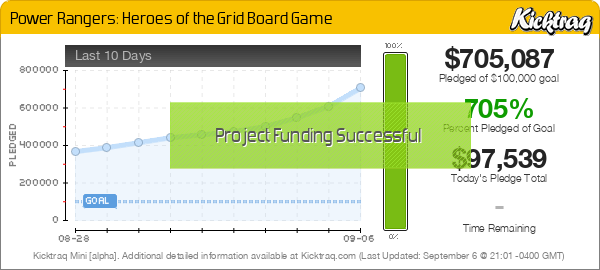
Power Rangers: Heroes of the Grid Board Game -- Kicktraq Mini

My History With Board Games - Part 2

Hello, hello!  Y'know, I feel like I spend a lot of time apologizing for not being around, but hey, sorry I haven't been around.  I ...

Popular Posts